Aluminum vs. Bamboo vs. Wood Wind Chimes: Which Should You Choose?
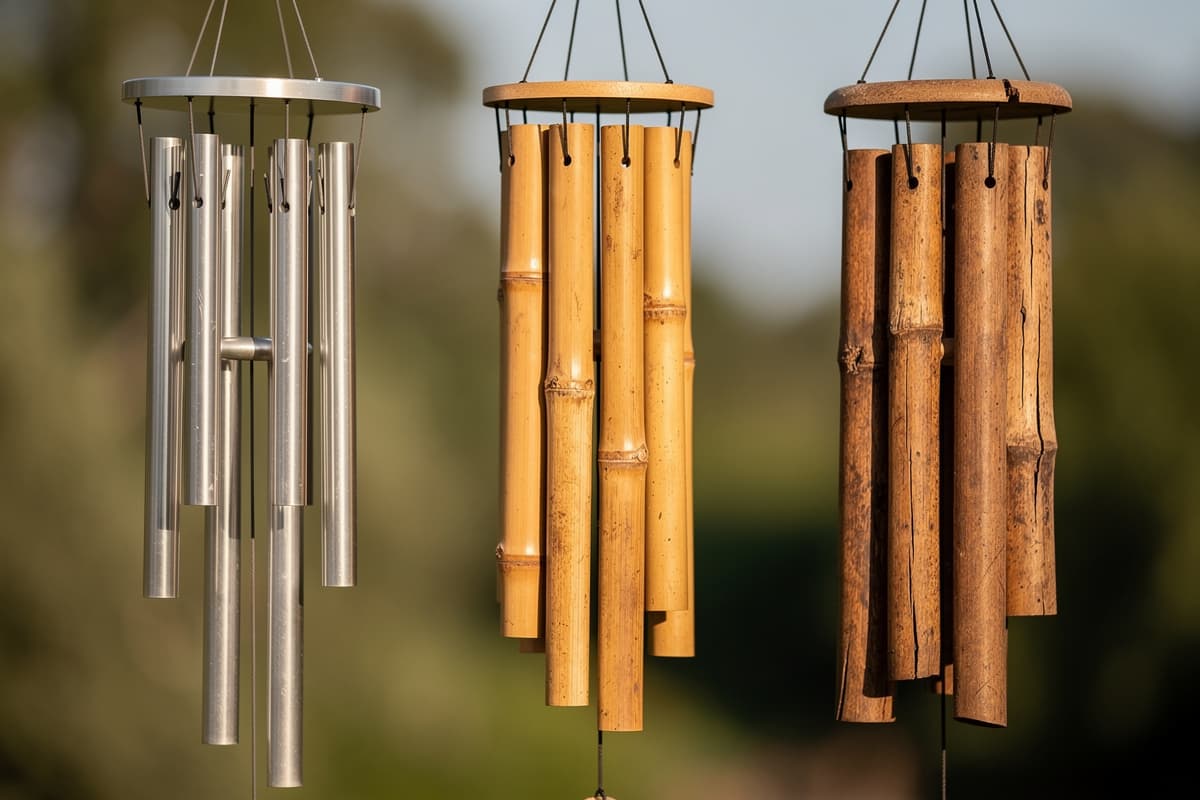
The first time I really paid attention to the difference between wind chime materials was at an outdoor market where three sets were hanging within a few feet of each other: a long aluminum set, a cluster of bamboo tubes, and a wooden set with driftwood-looking pipes. A gust came through and all three rang at once. Same wind, completely different sounds. The aluminum was bright and sustained, still ringing ten seconds later. The bamboo was a short, warm knock, almost percussive. The wood was somewhere in between, deep and muffled, more like a hollow thud than a ring.
I stood there longer than was probably socially acceptable trying to understand why they sounded so different when the physical setup was essentially the same. The answer is in the material properties themselves. Once you know what to listen for, it changes how you choose a chime.
Why Material Matters Acoustically
The sound of any wind chime tube is determined by two material properties working together: stiffness (Young's modulus, E) and density (ρ). Stiffness determines how fast vibrations travel through the material. Density determines how much mass has to be moved. The ratio E/ρ, called the specific stiffness, sets the fundamental frequency for a tube of a given size.
Beyond frequency, two other material properties shape the character of the sound:
- Internal damping: how quickly the material absorbs the vibration energy. Low damping = long sustain. High damping = short, dry decay.
- Overtone structure: the inharmonic partials unique to each material's elastic behavior. These are what give each material its "voice."
Metal (particularly aluminum and steel) has very low internal damping and high stiffness. Bamboo has moderate stiffness and higher damping. Wood varies enormously by species but generally has the highest damping of the three.
Aluminum Wind Chimes
Aluminum is the dominant material for wind chimes in the Western market, and it has earned that spot. It offers an excellent combination of low density and moderate stiffness, and what matters most for chimes, very low internal damping. When you strike an aluminum tube, the energy stays in the vibration for a long time. A well-made aluminum chime in a quiet space will ring for 30 seconds or more after a light tap.
The overtone character of aluminum is bright and complex. The inharmonic partials sit relatively high in frequency, which gives the sound a shimmering, metallic quality that carries well outdoors. This is the sound most people picture when they think "wind chimes": clear, sustained, unmistakably musical.
The tradeoff: that brightness and sustain can work against you in small or hard-walled spaces. A large aluminum set on a covered patio with a lot of concrete will reflect sound around and can feel overwhelming. The same set in an open backyard with grass and trees is perfect. I've heard beautiful aluminum chimes turn unpleasant in the wrong environment. The chimes were well made; the space just wasn't absorbing enough of the decay.
Best for: open outdoor spaces, gardens, patios without solid walls on multiple sides, anyone who wants that classic bright chime sound, people who want the tone to carry a distance.
Look for: aluminum alloy (6061 is common), wall thickness that's not too thin (you want some body to the tube), and specified tuning. The finish matters for weathering. Powder-coated or anodized tubes last much longer than raw aluminum outdoors.
Bamboo Wind Chimes
Bamboo is as far from aluminum as you can get while still calling it a wind chime. The material is dense and heavily damped, so energy dissipates rapidly in the structure of the fibers. Strike a bamboo tube and the sound lasts for a second or two at most, sometimes less. There's no long ring, just a warm, dry knock with a woody fundamental and almost no bright overtones.
That short voice is the whole character of the instrument, and plenty of people prefer it.
Bamboo chimes are more percussive than tonal. Each strike sounds complete in itself, a soft hollow knock with no sustained resonance trailing after it. In a gentle breeze, a bamboo set produces a soft, irregular tapping that sits in the background without demanding attention. In a strong wind it gets louder but never harsh, because there's simply no high-frequency content to get piercing.
The other thing bamboo has going for it is variation. No two bamboo tubes are exactly the same in density or fiber structure, which means the pitch and attack of each tube is slightly irregular. A well-tuned metal set has mathematical precision; bamboo has organic imprecision. For meditation and background sound, I'd argue the imprecision works in bamboo's favor. It keeps the pattern from becoming too predictable, so the brain never fully tunes it out.
The tradeoff: bamboo is less durable outdoors than metal. UV exposure bleaches it, moisture can cause cracking over time, and cheap bamboo chimes use low-quality cord that degrades fast. A well-made bamboo chime with treated surfaces and good cord lasts many years; a cheap one from a garden center might last one season.
Best for: covered porches, indoor use, meditation spaces, small patios or balconies where a sustained aluminum chime would feel too loud, anyone who wants something warm and understated instead of bright and musical.
Look for: natural bamboo over dyed or painted (it weathers better), stainless or UV-treated cord, and tubes that are sealed at the ends. Open-ended bamboo collects moisture and splits faster.
Wood Wind Chimes
Wood is the most variable of the three categories because "wood" covers an enormous range. Redwood, maple, teak, pine, cedar, and driftwood are all used in chimes, and they behave quite differently. But as a category, wood sits between bamboo and aluminum in both sustain and brightness.
A wooden chime has more sustain than bamboo but nothing close to aluminum. The overtone structure depends heavily on the specific wood and how it's finished, but tends toward warm midrange tones with limited high-frequency shimmer. Dense hardwoods (teak, maple) produce cleaner, more sustained tones. Lighter woods (pine, cedar) are shorter and softer. Driftwood and reclaimed pieces, common in the artisan market, are the most variable of all, sometimes producing beautiful irregular tones and sometimes just thudding.
What wood does especially well is integrate with outdoor environments. A wooden chime in a garden looks inherently natural in a way metal doesn't, and the acoustic character is similarly unobtrusive. It doesn't pierce or carry the way aluminum does. It sits closer to ambient noise levels, so it reads as part of the outdoor soundscape, not an addition to it.
The tradeoff: wood requires more maintenance than metal. Most outdoor wood chimes need periodic oiling or sealing to prevent cracking, and the cord typically needs replacement every year or two in harsh climates. A well-maintained teak or cedar chime is beautiful for decades; a neglected one deteriorates quickly.
Best for: garden settings, people who want something that looks and sounds natural, situations where subtlety matters more than projection, buyers who prefer artisan over mass-produced.
Look for: hardwoods over softwoods for durability, exterior-grade finish or oiled natural wood, quality suspension hardware (metal hooks rather than plastic fittings).
The Materials Side by Side
| Property | Aluminum | Bamboo | Wood |
|---|---|---|---|
| Sustain | Long (20-40 sec) | Short (1-3 sec) | Medium (5-15 sec) |
| Brightness | High | Low | Medium |
| Volume | High | Low to medium | Medium |
| Durability outdoors | Excellent | Moderate | Moderate |
| Maintenance | None | Low | Medium to high |
| Best environment | Open outdoor | Covered/indoor | Garden/natural |
| Character | Musical, ringing | Warm, percussive | Mellow, natural |
Shell, Stone, and Glass: The Others
Shell, glass, and stone chimes don't fit neatly into the three-material framework above, but they're worth knowing about.
Shell chimes (usually capiz shell or coconut shell) have a unique acoustic profile. The irregular shapes produce unpredictable, non-pitched sounds closer to a soft shimmer than a musical tone. They're more decorative than acoustic, but in the right space (a coastal house, a porch with a water view) they're quietly lovely.
Glass chimes are relatively high-damping: shorter sustain than aluminum, cleaner than bamboo, with a distinctive crystalline quality when tubes strike each other. They're fragile outdoors, so they're mostly suited for covered spaces.
Stone chimes (slate is common) are heavy and slow, with a deep, muted thunk. Very short sustain, very low frequency. Unusual but effective for grounding ambient sound; they feel substantial in a way lighter materials don't.
My Recommendation
If you're buying your first outdoor wind chime and want it to sound musical: aluminum, properly tuned, sized for your space. Get a set that specifies its tuning (pentatonic is safest). Pay attention to tube length, since longer tubes are louder and lower, and that matters for whether you're hanging this on a small balcony or in a large yard.
If you're working in a small space, a covered porch, or indoors, or you want something meditative and background instead of musical and present: bamboo. Spend a little more for a well-made set with sealed tubes and good cord. Cheap bamboo chimes are not worth the savings.
If you care as much about how your chime looks as how it sounds, or you want something that fits a garden aesthetic: hardwood. Teak is my preference for outdoor durability. Accept that it needs some upkeep.
I own all three. The aluminum set is on the back of the property where the wind hits cleanly; it's the one I hear from inside the house on a breezy afternoon. The bamboo hangs near where I read, close enough that I can hear it without effort. The wood chime is purely decorative in a garden corner. I barely register its sound, but I notice its absence. Each one is doing a different job.
How Material Sounds in Vibe Chimes
The simulation in Vibe Chimes models each material's stiffness, density, and damping coefficient separately. Switching from aluminum to bamboo doesn't swap in a different recording. It changes the physical parameters: shorter decay time, lower overtone frequencies, reduced brightness. The same physics that separates a real aluminum chime from a real bamboo chime is running in the browser, just in real time from a collision event instead of a mallet strike.
If you want to hear the difference for yourself without committing to a purchase, ten minutes in Vibe Chimes with the material selector gets you surprisingly close to the real thing.
Next up: how tube length determines pitch. The math behind why longer tubes always sound lower, and how wind chime makers cut tubes to produce exact musical intervals.