A History of Wind Chimes: From Ancient China to Your Back Porch
Most objects we hang in our homes have a history measured in decades. Wind chimes have a history measured in millennia. The oldest documented wind chimes (bronze bells strung to catch the wind) date to ancient China around 1100 BCE, making them roughly contemporary with the earliest written Chinese characters. For something that sounds so simple, they've been remarkably persistent across cultures and continents.
What strikes me as a physicist reading their history is how consistently different cultures arrived at the same basic insight: sound produced by wind, on no schedule, carries a different quality than sound produced by human intention. Every culture that developed wind chimes seems to have discovered independently that this particular kind of sound is restful in a way that deliberate music often isn't.
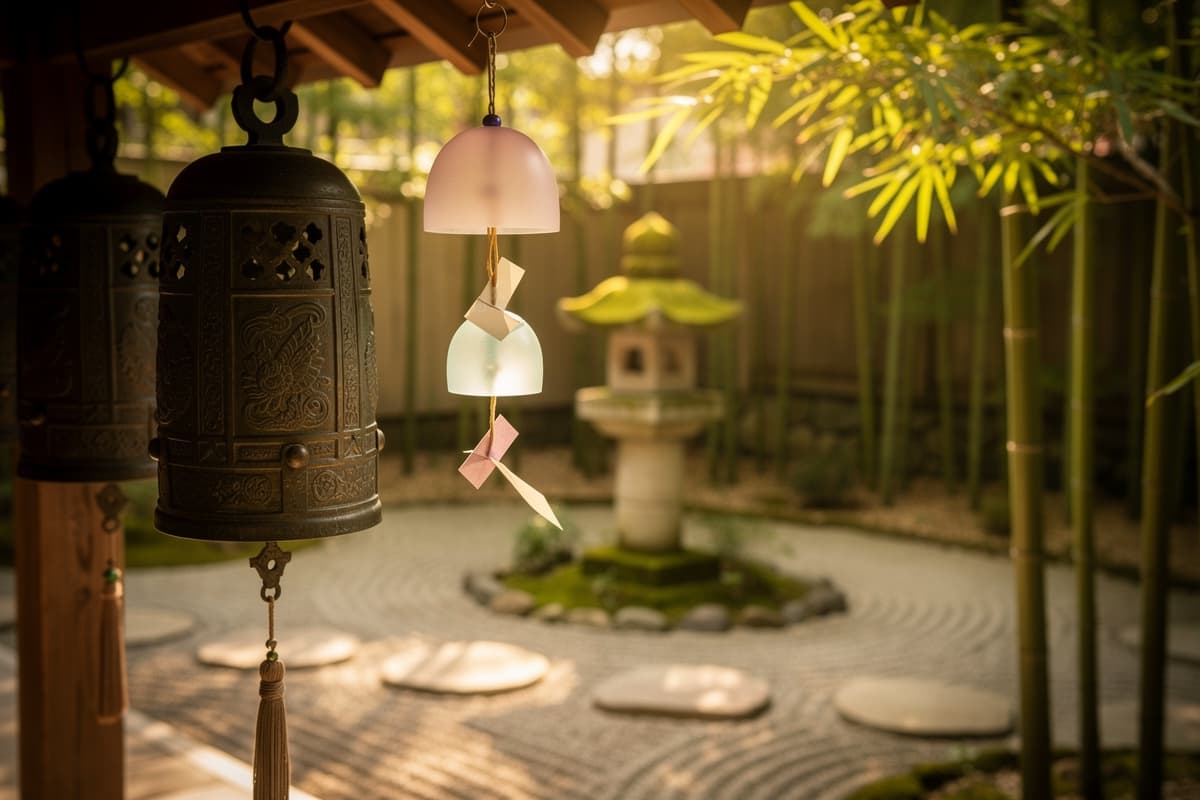
Ancient China: The Earliest Wind Chimes
The earliest wind chimes in the archaeological record are Chinese, dating to the Shang and Zhou dynasties (roughly 1600-256 BCE). These were a far cry from the gentle decorative objects we hang on porches today: ceremonial bronze bells called nao and zhong, cast in graduated sizes and suspended from wooden frames to produce specific pitches.
The wind-responsive version, a lighter bell or set of bells designed to ring in a breeze, appears in Chinese records around 1100 BCE. These were called fengling (風鈴), literally "wind bell," and were used both for spiritual purposes (ringing as a communication from the spirit world) and for practical ones (alerting residents to approaching weather or intruders).
By the Tang Dynasty (618-907 CE), fengling had become integrated into feng shui practice. Their placement near structures was believed to harmonize the flow of qi, the vital energy that feng shui practitioners sought to moderate through architectural and environmental design. Metal bells near entrances were thought to slow and harmonize incoming energy; bamboo chimes in garden spaces softened what practitioners described as "sha qi," the sharp or cutting energy associated with linear paths and pointed angles.
The feng shui use of wind chimes persisted through subsequent dynasties and remains influential today. The specific guidelines around rod counts, materials, and compass directions in modern feng shui practice trace directly to Tang and Song dynasty texts.
Japan: The Fūrin Tradition
Japan developed its own wind chime tradition independently, though with clear influence from Chinese trade and cultural exchange. The Japanese fūrin (風鈴), written with the same characters as the Chinese fengling, emerged as a distinct art form during the Edo period (1603-1868).
The Edo-era fūrin has a characteristic form that remains largely unchanged today: a small glass or metal bell body with a flat sail (a thin strip of decorated paper or fabric) hanging below it. Unlike the Chinese hanging-tube format, the fūrin rings when wind catches the sail and causes the internal clapper to strike the bell body. The sound is a single clear tone, brief and crystalline, very different from the sustained ring of a metal tube chime.
Glass fūrin from the Edo period became particularly associated with summer in Japan. The sound of fūrin on a hot afternoon was considered cooling, psychologically if not physically. It was said that hearing the brief chime of a fūrin in the breeze helped the listener feel as though a cooling wind had passed, even on still days. This psychoacoustic effect (sound creating a sensation of air movement) has some modern research support: the brain's association of certain sounds with environmental conditions like wind, water, and temperature can trigger mild physiological responses.
Fūrin making became a specialized craft in Japan, with regional styles developing in Edo (Tokyo), Kyoto, and Osaka. Nanbu ironware fūrin, cast in the iron foundry tradition of the Iwate region, are considered among the finest: heavy, deep-toned, with a resonance that outlasts lighter glass bells.
Today, fūrin festivals are held across Japan in summer, and traditional fūrin shops in older city neighborhoods remain going concerns, with regular customers who come back each year to replace or add to their collections.
Southeast Asia: Bamboo Traditions
Across Southeast Asia (Indonesia, the Philippines, Thailand, Vietnam, and neighboring countries), bamboo wind chimes developed as both functional and ceremonial objects. Bamboo's abundance in these climates made it the obvious material, and its short, warm, percussive acoustic character suited the dense, reverberant environments of tropical gardens and covered structures.
In Bali, bamboo chimes called tingklik are used both decoratively and as mild pest deterrents in rice paddies. The irregular rattle of bamboo in wind discourages birds in a way that regular, predictable sounds don't. It's a practical application of the same chaotic timing that makes wind chimes meditative.
Philippine bamboo craft includes elaborate wind chimes made from graduated tubes, sometimes incorporating seashell elements, that become true musical instruments when hung where wind can play them. The tradition of integrating wind instruments into garden and agricultural spaces is essentially continuous from ancient practice to the present day.
The Western Tradition: Aeolian Instruments
Western Europe developed a parallel but distinct tradition around wind-activated instruments. The Aeolian harp, named for Aeolus, the Greek god of wind, was a stringed instrument designed to be placed in a window or outdoor setting where wind would bow across the strings, producing chords that changed with wind speed and direction. References to Aeolian harps appear in Greek and Roman texts, and they experienced a major revival during the Romantic period (late 18th to 19th century).
Romantic poets including Shelley, Coleridge, and Keats wrote about Aeolian harps as symbols of nature-driven creativity: sound that arose without human intention, purely from the interaction of wind and form. Coleridge's The Eolian Harp (1795) is perhaps the most famous literary meditation on this theme, treating the harp as a metaphor for the mind moved by forces beyond its control.
The Western tradition never developed hanging tube chimes to the same extent as East and Southeast Asian cultures, but the underlying sensibility is identical: wind-produced sound carries a quality of its own.
The Modern Aluminum Chime
The mass-market wind chime as we know it today (aluminum tubes, tuned to a pentatonic scale, sold at garden centers) is largely a 20th-century American development. The key innovation was precision-cut aluminum tubing, which could be manufactured to tight tolerances and tuned accurately at scale.
The shift from decorative to deliberately tuned chimes began in earnest in the 1970s and 1980s, driven partly by the New Age movement's interest in healing sound and meditation. Manufacturers began advertising chimes by their tuning ("pentatonic," "432 Hz," "Gregorian"), and the market for high-quality tuned chimes emerged as a distinct category separate from purely decorative objects.
Today the range spans from dollar-store noise-makers to handcrafted, precision-tuned professional instruments. At the high end, American makers like Woodstock Percussion and Corinthian Bells produce chimes tuned to within a few cents of their target frequencies, using aerospace-grade aluminum alloy and hand-finished hardware. These are instruments in the full sense, designed first for acoustic quality and second for appearance.
What Has Stayed the Same
What's striking about the full history is what hasn't changed. Across 3,000 years and a dozen distinct cultural traditions, wind chimes have consistently been valued for the same quality: sound produced by something other than human intention, at intervals that can't be predicted, in tones that are pleasant instead of alarming.
The physics explains some of this consistency. Wind-activated sound sources naturally produce the irregular, unpredictable timing that the brain finds restful. Tube and bell shapes naturally produce partials in the inharmonic range that sounds complex and interesting without being dissonant. None of that depends on culture. They're acoustic properties interacting with universal features of human auditory processing.
What different cultures brought was their own material traditions, aesthetic frameworks, and spiritual interpretations. The sound quality at the center of all of them is the same.
Curious how these acoustic properties behave in real time? Vibe Chimes runs the same physics that made ancient Chinese bronze bells restful, right in your browser.