Why Wind Chimes Sound Different in Different Weather
Anyone who's paid close attention to a wind chime through the seasons has probably noticed that it doesn't behave the same way year-round. The same chime can sound fuller on a warm afternoon than a cold morning, ring differently in humid summer air than dry winter air, and respond to a gusty spring wind very differently than to a steady summer breeze. Some of this is obvious (more wind means more ringing), but the subtler changes are more interesting, and they reveal something about what's happening physically when a chime tube rings.
Being someone with a physics background, I've spent time working out which of these differences are real and which are perceived, and the answer turns out to be: mostly real. Your chime is a living barometer in several distinct ways.
Temperature: Pitch Shifts Are Real
The speed of sound in air depends on temperature. At 20°C (68°F), sound travels at about 343 meters per second. At 0°C (32°F), it drops to about 331 m/s. At 35°C (95°F), it rises to about 352 m/s.
For wind chimes, this matters in a subtle but real way. The fundamental frequency a tube produces depends on its physical properties (stiffness, density, length), but the propagation of that sound, and specifically the resonant coupling between the tube and the surrounding air, changes with temperature.
More directly, the pitch you perceive from a ringing tube is primarily determined by the tube's mechanical resonance, which is a function of its material properties and doesn't change significantly with temperature. But the very slight thermal expansion of metal tubes in warm weather does affect their length. Since frequency scales with the inverse square of length, a tube that expands by 0.1% due to heat will fall flat by about 0.2%. For a standard wind chime, this effect is smaller than most people would notice consciously, but it contributes to a general impression of "warmth" in the sound on hot days.
What you're more likely to consciously notice: a cold chime sounds stiffer and brighter. Metal at cold temperatures has slightly different damping characteristics than warm metal, because the internal friction that dissipates vibration energy changes with temperature. Cold aluminum rings a bit sharper and with a slightly harder attack than warm aluminum. If you've ever noticed your chime sounding more metallic and edgy on a cold morning than a warm afternoon, this is likely what you're hearing.
Humidity: The Bamboo Effect
Humidity has a modest effect on metal chimes but a significant effect on bamboo and wood.
For metal tubes, increased humidity slightly increases the density of the surrounding air, which has a marginal effect on sound propagation. The effect on pitch and character is negligible.
For bamboo, humidity is a major variable. Bamboo is hygroscopic: it absorbs moisture from the air. A bamboo tube in high humidity is heavier and slightly softer than the same tube in dry air. This increases its internal damping, making the tone even shorter and drier than usual, and it may shift the pitch slightly flat (heavier tube = lower frequency). After a rainy spell, a bamboo chime sounds noticeably more muffled than the same chime in dry summer heat.
This is also why bamboo chimes need to be dried thoroughly before tuning. A bamboo tube cut and tuned in high humidity will ring sharp when that same tube dries out, a mistake that ruins the tuning of many DIY bamboo projects.
Wood chimes show similar humidity sensitivity, particularly softer woods. Teak and other dense hardwoods are more stable. This is one reason teak is the preferred wood for outdoor chimes in variable climates.
Wind Type: Turbulence vs. Laminar Flow
This is the variable I find most interesting acoustically, and the one that most directly determines the rhythm and character of a chime session.
Laminar flow is smooth, organized air movement, the kind you get from a gentle, steady breeze moving across an open field or a smooth water surface. In laminar flow, the sail of a wind chime receives consistent pressure and swings with a regular, predictable arc. The result is rhythmic and measured. The chime rings at intervals that have a pattern, almost like a slow pendulum. It sounds musical and organized.
Turbulent flow is chaotic, mixed air movement, the kind you get from wind deflected around buildings, through gaps, across uneven terrain, or during weather fronts. Turbulent flow hits the chime sail with varying pressure and direction, producing irregular swings, sudden gusts, and brief lulls. The result is the characteristic wind chime sound most people love, unpredictable and alive: a quiet strike, a brief cascade, then silence.
Most outdoor chime positions generate some degree of turbulence, which is why the natural sound of a wind chime has that appealing irregularity. Positions in completely open, unobstructed spaces with consistent prevailing winds are rare.
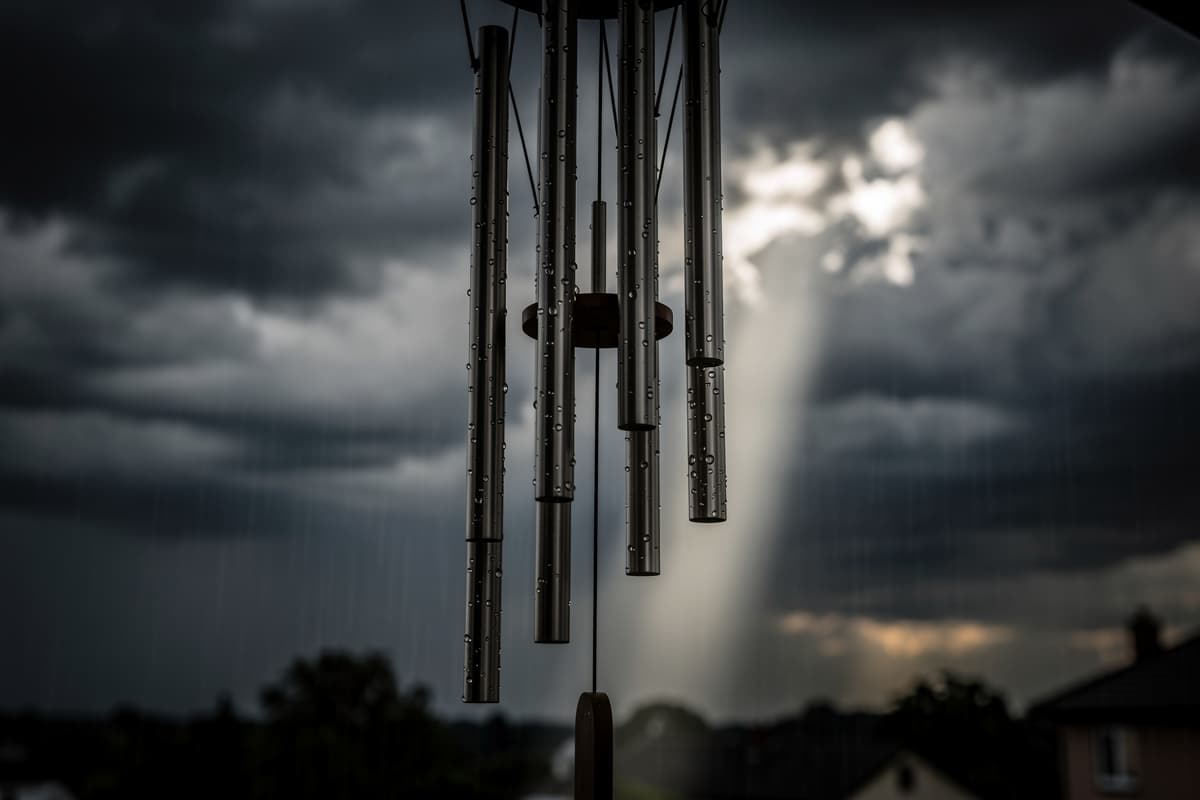
During weather fronts, as a storm approaches or wind direction shifts, the turbulence increases dramatically. This is when chimes are most active and most interesting to listen to. There's a particular quality to the sound of a chime in the minutes before rain, when pressure changes and the wind becomes variable. The chime seems to sense the approaching storm before you can see or feel it clearly.
Seasonal Behavior
Putting these factors together explains why chimes behave differently across seasons:
Summer: Warm air, often moderate humidity, frequent thermobaric breezes (warm air rising and cooler air filling in) that produce gentle, variable wind. Chimes ring gently and irregularly. Metal sounds slightly warmer and less hard than in winter. Bamboo may be slightly more muffled in high humidity.
Autumn: Transitional weather with frequent fronts produces the most interesting and variable chime behavior. Pressure changes, wind direction shifts, and the approach of cold fronts create highly turbulent, irregular air. Many people find autumn the best season for wind chimes; the sound matches the season's character perfectly.
Winter: Cold air makes metal bright and edgy. Low humidity (especially in heated indoor environments, if you've moved a chime inside) makes bamboo ring more crisply than usual. Reduced foliage means wind moves more directly and less is buffered, which can make exposed chimes overactive in windy climates.
Spring: Variable and gusty, with the energy of changing weather. Chimes are active but sometimes overdone; a heavy spring gust can overwhelm a light sail. This is the season where position matters most. A chime too exposed to prevailing wind may be more clattering than pleasant.
The Chime as Weather Instrument
There's an old practical use of wind chimes as weather indicators: fishermen and farmers noticed that changes in a chime's behavior (sudden unusual activity, a change in the rhythm or direction of ringing) often preceded significant weather changes. The turbulence associated with approaching weather fronts activates chimes in characteristic ways that correlate with impending conditions.
No mysticism required. Pressure changes and shifting air mass boundaries create turbulent, variable wind that the chime responds to before a human sensor would notice. A well-hung chime in a good position is a wind instrument in both meanings of the word: a musical instrument and an instrument for reading the wind.
Vibe Chimes' Live Weather mode connects to real weather data and drives the simulation from actual wind speed and direction at your location, so the chime behaves differently on a calm day than a stormy one, just as a real chime would.