Wind Chime Repair: How to Fix the Most Common Problems
A wind chime that's spent a few seasons outdoors will eventually need attention. Cords degrade, strikers go missing, tubes dent or bend, and wooden components crack. Most of these problems are straightforward to fix if you know what you're doing, and fixing a chime you've had for years is usually more satisfying than buying a replacement.
I've repaired several sets at this point, including one set that survived a tree branch dropping on it (two tubes bent, three cords snapped, the platform cracked) and came out sounding fine afterward. The repairs took about an hour and cost under five dollars in materials. Here is a systematic guide to the most common problems.
Diagnosing the Problem
Before starting any repair, take the chime down and inspect it fully:
- Hold each tube individually and tap it. Does it ring freely, or is the tone muffled or absent?
- Check every cord segment for fraying, UV degradation (a chalky, stiff appearance), or cuts
- Verify the striker hangs at the right height to contact the tubes
- Check the wind catcher sail: is it intact, is the cord sound?
- Inspect the top platform for cracks, loose holes, or hardware problems
This diagnosis saves you from fixing one thing and then discovering another problem requires the whole chime to come apart again.
Replacing Broken or Degraded Cord
Cord failure is the most common wind chime repair. Nylon and polyester cord degrade under UV exposure over 2 to 5 years depending on your climate and sun exposure. The cord becomes brittle and stiff before it breaks. When you bend it sharply and it whitens or cracks, it's time to replace it, even if it hasn't snapped yet.
What you need: Replacement paracord or nylon mason line (1/16 to 3/32 inch diameter works for most chimes). Buy more than you think you need; it's cheap and you'd rather have extra.
Process:
- Before removing any cord, photograph the chime from multiple angles. A reference photo prevents confusion about which tube hangs where and at what height.
- Remove all old cord. If tubes are hung at different heights, note or measure those heights relative to the platform bottom.
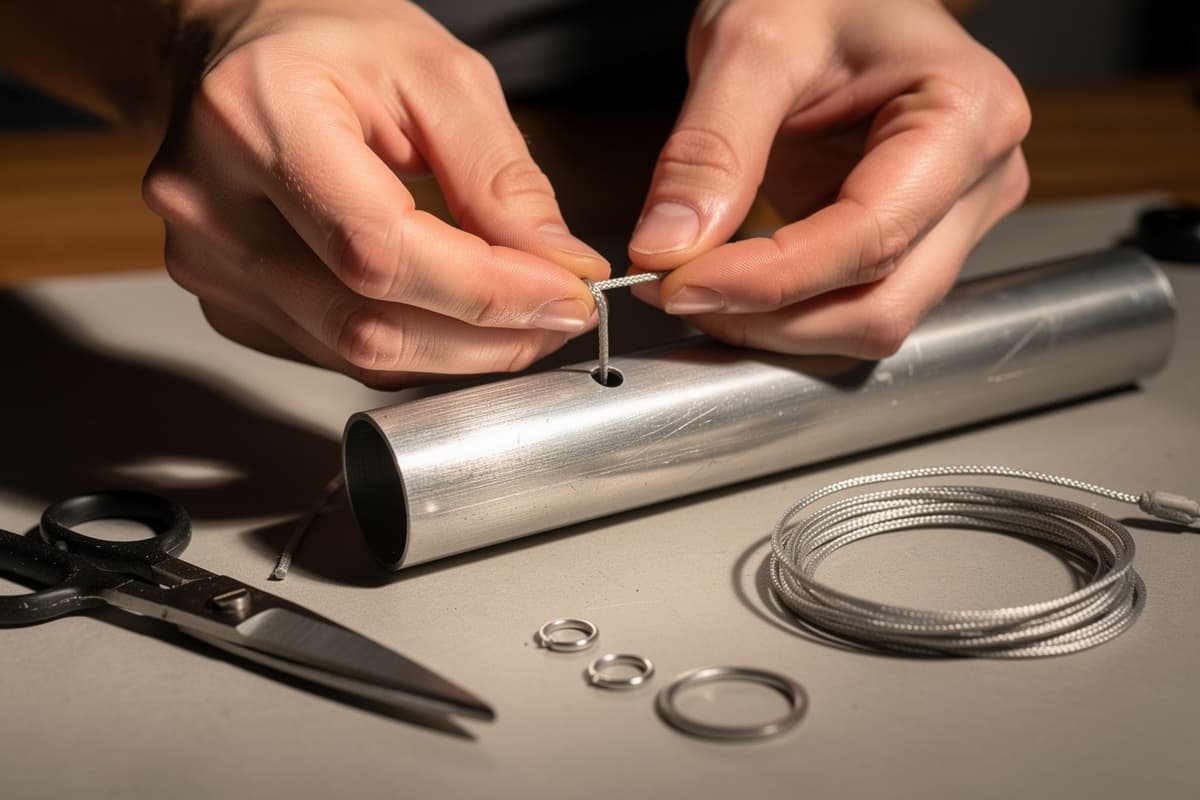
- Thread new cord following the original stringing pattern. Pass cord down through the platform hole, through the tube's suspension hole, back up through the platform, and tie off with two half-hitches or a figure-eight stopper knot.
- Verify each tube hangs level. A tube that tilts has uneven cord running through its suspension hole; re-thread it with the cord centered.
- Burn the cut cord ends lightly with a lighter to prevent fraying (for nylon and polyester; not for natural fiber).
The suspension hole position: If you're rehanging a tube that's come completely free, the suspension hole should be at 22.4% of the tube length from either end. This is the nodal point, the spot where the tube doesn't vibrate at its fundamental frequency, so hanging from here doesn't damp the tone.
Fixing a Striker That's Wrong or Missing
The striker (the bead or short rod that hangs in the center and strikes the tubes) is often the first thing lost if a chime partially disassembles. It's also easy to get the height wrong when reassembling.
Missing striker: Any dense, smooth object of appropriate size works: a large wooden bead, a short section of dowel, a stone bead. The striker should be heavy enough to swing into the tubes with momentum but not so heavy that it dents them. For aluminum tube chimes, hardwood or heavy plastic beads work well. For bamboo, even a lighter bead is enough since bamboo dents easily.
Wrong height: The striker should contact the tubes at roughly their midpoint (half to two-thirds of the way down their length). Too high and it only grazes the upper portion, producing a weak, thin strike. Too low and it misses entirely or only catches the lowest section. Adjust the cord length between the striker and the platform until the striker sits at the right height relative to the tubes.
Striker too light: A striker that barely moves in moderate wind produces a chime that rarely rings. Replace it with a heavier bead.
Striker too heavy: A very heavy striker rings constantly in light air and can dent softer tube materials. Replace with a lighter bead, or reduce the sail size to limit swing amplitude.
Fixing a Dented or Bent Tube
Minor dents in aluminum tubes don't usually affect the sound much. The tube vibrates along its length, not across its diameter, and surface imperfections have minimal effect on the fundamental frequency. If a tube has a small dent but rings clearly, leave it.
Significant bends are a different matter. A bent tube hangs incorrectly, may contact other tubes at rest, and the deformation affects its vibrational modes. Minor bends (less than about 5 degrees) can sometimes be straightened:
- Clamp the tube in a padded vise at a point away from the bend
- Apply slow, even pressure to bend it back. Go gradually, because aluminum work-hardens if you try to reverse a bend too quickly
- Check with a straightedge after each adjustment
Tubes bent more than about 10 degrees are rarely worth trying to straighten. The metal has stressed unevenly and the tube will likely crack before it's fully straight. Use the bent tube for a different purpose and cut a replacement.
Cutting a replacement tube: Measure the original length of the damaged tube. Cut the replacement slightly long (a quarter-inch over). File the ends smooth, drill the suspension hole at 22.4% from one end, hang it, and check the pitch with a tuner. Trim in small increments until it matches the original pitch.
Repairing Wooden or Bamboo Components
Platform cracks: Small cracks in a wooden platform are usually cosmetic and structurally fine if the hole positions are intact. Fill with exterior wood glue, clamp until set, and refinish. If a crack passes through a cord hole, re-drill the hole after the glue sets.
Bamboo tube splitting: Bamboo splits when moisture gets inside and then freezes, or when the tube is exposed to alternating wet/dry cycles without sealing. A split tube doesn't ring correctly and should be replaced. To prevent future splits, seal the cut ends of bamboo tubes with wood glue, beeswax, or epoxy before hanging.
Sail damage: A cracked or warped wooden sail can be replaced with any thin, flat piece of exterior-grade wood, painted or sealed. Match the approximate weight and size of the original. The sail's job is to catch wind and transfer it to the striker, and its mass relative to the striker matters for how responsively the chime rings.
Weatherproofing for Longevity
Once a repair is complete, take the opportunity to weatherproof the whole chime:
- Cord: A light application of beeswax or silicone lubricant on nylon cord extends UV life significantly
- Wood: Re-coat any wooden components with exterior spar varnish, tung oil, or an equivalent. Pay particular attention to end grain, which absorbs moisture fastest
- Aluminum tubes: Anodized or powder-coated finishes are largely self-maintaining; raw aluminum develops a patina that protects the underlying metal. If appearance matters, a light coat of clear lacquer extends the bare aluminum finish
- Hardware: Replace any corroded steel hardware with stainless or coated alternatives. A single rusted hook or ring can stain a wooden platform permanently
When to Replace Instead of Repair
A chime is worth repairing when the tubes are in good condition and the structural elements are fixable. It's probably time to replace when:
- Multiple tubes are bent, cracked, or significantly out of tune and you can't source replacements
- The platform has structural damage that affects how tubes hang (not just cosmetic cracking)
- The original material quality was low enough that the repair cost exceeds the replacement cost
Most chimes from quality makers are absolutely worth repairing. The tube quality and tuning that made them sound good in the first place are exactly what you're preserving. Cheap decorative chimes with random-interval tubes are less worth the effort; a replacement of similar price will sound the same or better.
If you want to experiment with different materials, sizes, and configurations before investing in a new chime, Vibe Chimes lets you hear how each combination sounds.