How to Hang Wind Chimes for the Best Sound
A wind chime is only as good as the air around it. The very same chime can sound like a distant temple bell or a tangle of clatter depending entirely on where you hang it. Placement is the quiet variable most people overlook. They spend time choosing the right chime and then hang it in the first available spot. Here is how to find a spot that lets a chime breathe.
Start With the Air, Not the Hook
Before you pick up a drill, spend a few days (ideally a week) observing how air moves around the area where you're thinking of hanging the chime. Watch for:
- Where leaves move on still days (this reveals gentle circulation, the kind that activates a chime without overwhelming it)
- Where smoke or steam from a grill or vent drifts (this shows the dominant air current direction)
- Whether the spot has gusty, turbulent air or smooth, steady flow
Turbulent air produces irregular, choppy chime behavior: lots of rapid strikes followed by periods where the chime tangles on itself. Smooth, laminar airflow produces the clean, unhurried rhythm you're aiming for. Corners, narrow gaps between structures, and air that's been redirected around a wall tend to be turbulent. Open spans, porch eaves at the front of the prevailing wind, and overhangs with clearance below tend to give smoother flow.
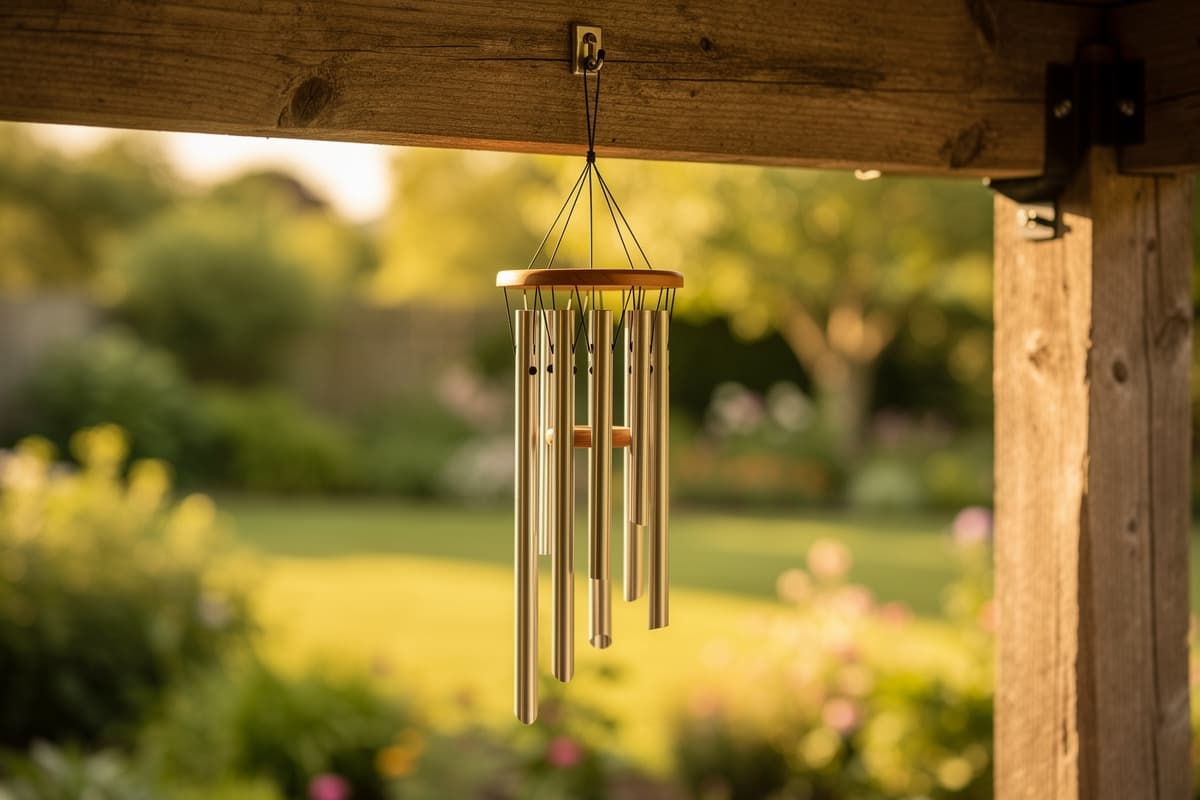
The classic positions are: a porch eave, a pergola or arbor crossbeam, a corner of a balcony, or a tree branch with good clearance. These work because they tend to catch smooth, channeled air, not just because there happens to be a place to put a hook.
Finding the Right Exposure
The relationship between wind exposure and chime behavior is worth understanding explicitly:
Too much exposure: A chime that faces the full prevailing wind plays constantly. This sounds appealing until you've lived with it for a week. Constant activity is fatiguing; you stop hearing it as ambient and start hearing it as noise. A large aluminum set in full wind is loud and relentless.
Too little exposure: A chime tucked behind a wall or in a deep corner rarely speaks. You've essentially silenced it. Some people accidentally do this with covered porches that have walls on three sides.
The sweet spot: Partial shelter. You want the chime to catch wind but have some protection from the strongest gusts. A porch that's open on one or two sides, with the chime positioned near the open edge but not fully exposed. A tree branch that moves in a breeze but has canopy above reducing peak gust intensity.
For a balcony, hang the chime at the outer corner (the spot where it gets the most airflow) but not extended out past the railing where it takes full unbroken wind.
Height and Clearance
How high to hang it: High enough that it clears heads and swings freely; low enough to stay in earshot. For a porch or patio, roughly eye level to a foot or two above eye level is ideal. A chime hung too high disperses its tone before it reaches seated listeners. The sound radiates in all directions from the tubes, and if the source is too far overhead, you're catching only the scatter, not the direct sound.
Clearance in all directions: The chime needs room to swing without striking anything. Give it a radius of clearance equal to at least half its total width on all sides. A chime that knocks against a wall, post, or railing produces a flat, dead sound on impact: you hear the object being struck instead of the tube ringing freely.
Clearance for the sail: The wind catcher at the bottom needs to swing without catching on anything. If the sail can't pivot freely, the chime won't activate properly. Check below as well as around. Potted plants, railings, and furniture edges can all catch a sail on a gusty day.
How Surfaces Change the Sound
This is the most underappreciated variable in chime placement, and the most interesting acoustically.
Hard surfaces nearby act as sound reflectors. A chime hung where two walls meet (an interior corner of a porch, say) sounds fuller and more resonant than the same chime in open space, because the walls gather and amplify the reflected sound back toward you. The tubes ring into a reflecting environment instead of open air, and the effect can be beautiful. The same chime sounds richer and more present.
The downside is that in very small, hard-walled spaces, this reflection becomes too much. The sound accumulates and feels overwhelming. A covered patio with concrete walls on three sides and a low ceiling is a challenging acoustic environment for any chime, especially a bright metal one.
Soft surfaces absorb sound. A chime hung in a garden with dense foliage behind it sounds softer and more natural. The vegetation absorbs the reflected energy and reduces the acoustic "room" that builds around the chime. This is ideal for a meditative, background sound.
Open exposure scatters sound. A chime in the middle of a yard with nothing nearby sounds thinner than the same chime on a porch. The tone disperses in all directions without anything to gather it back toward you.
General rule: for presence and fullness, position the chime with at least one reflective surface behind or beside it. For softness and subtlety, position it against soft or absorptive backgrounds like foliage, wooden fencing, or fabric awnings.
Indoor Hanging
Hanging wind chimes indoors is less common but worth knowing about. Indoors you're not depending on outdoor wind, so you need air movement from an open window, a ceiling fan, HVAC vents, or foot traffic near a doorway.
Near a window: The most reliable indoor activation. A chime hung just inside an open window catches the same breeze that would activate an outdoor chime, but at lower intensity. This makes smaller, more delicate sets ideal for indoor use; large outdoor chimes are too loud for most interior rooms.
Near a door: Good in theory, but inconsistent. A door that opens and closes sends a pulse of air through the room that activates the chime briefly. This works well for a light decorative chime near an entry; it's less suited as a continuous ambient sound source.
Ceiling fan draft: A gentle fan on a low setting creates consistent soft air circulation that activates a very light chime. This works best with small bamboo or shell sets. Anything too heavy or too tuned will clash with the fan's mechanical rhythm.
Acoustic note for indoors: Hard floors and ceilings make interior rooms acoustically live. Metal chimes that sound perfect outdoors can be piercing indoors. Bamboo, wood, and shell are almost always better choices for interior hanging.
Cord and Suspension Materials
The cord or line you use affects both the sound and the longevity of the chime.
Nylon and polyester cord: The most common and most weather-resistant. UV-stabilized versions last several years outdoors without degrading. The slight elasticity of nylon helps absorb impact energy, reducing the "thud" of the hanger and keeping the sound clean.
Natural fiber cord (cotton, jute, hemp): Looks beautiful and sounds slightly warmer, but degrades quickly outdoors. UV and moisture will break down natural fibers within a season in most climates. Fine for indoor chimes or sheltered covered porches; poor choice for full outdoor exposure.
Wire or thin metal chain: Used on some heavier or decorative chimes. Durable but transfers vibration from the mounting point back into the chime more than cord does, which can slightly dampen the tone. Also creates a metallic clicking sound against hardware that some people find grating.
Hook and mounting hardware: Use stainless steel or coated hardware to avoid rust stains on wood or concrete surfaces. A swivel hook (one that rotates freely) prevents the cord from winding up during rotation, which can cause the chime to bind and stop responding to the wind.
Material-Specific Placement Tips
Different chime materials have different ideal placements:
Aluminum: Wants open, exposed positions where it can project. Avoid placing large aluminum sets in small enclosed spaces. Best on open porches, pergolas, or tree branches with clear air.
Bamboo: More forgiving. It sounds good in both exposed and sheltered positions, and its quieter natural decay makes it suitable for spots closer to seating and sleeping areas. A covered porch corner is ideal.
Wood: Works best in garden settings where its natural character complements the environment. Sheltered from heavy rain if possible, since prolonged moisture softens the wood and eventually warps the tubes.
Shell and glass: Almost always better suited to covered, sheltered positions. Fragile and light, they belong close to a window or on a protected porch where you can hear their quiet tones without a gust destroying them.
Seasonal Adjustments
Where you hang a chime in spring may not be the best position year-round. Worth knowing:
- In summer, prevailing winds may come from a different direction than in winter. A position that catches light breezes in July may be in a dead zone in January.
- A position that works beautifully in fall may be too exposed in winter storms. Consider a secondary sheltered hook to move the chime during harsh weather.
- Light bamboo and shell chimes should generally come inside in climates with hard freezes. Moisture that gets into cracked bamboo expands when frozen and can split the tubes.
Tuning the Spot by Ear
The last step is the most important and the most overlooked: hang the chime, then actually listen for several days before deciding you're done. Move it a foot one way. Try it at a lower hook, or farther into the corner. Rotate it so the sail faces a different direction. Small changes shift the voice more than you would expect.
Listen for:
- Is it ringing at a comfortable frequency? (Often enough to enjoy, rarely enough that it never turns into noise)
- Does the sound reach where you sit, sleep, or work?
- Does it feel like something in the background, or does it demand attention?
You're tuning a relationship between wind, surface, and listener, and it takes a few iterations to get right. When you do, you'll know immediately.
If you want to hear how wind speed and direction reshape a chime before committing to a spot outdoors, try it in Vibe Chimes: dial the wind up and down, change its direction, and listen to how the same chime transforms across conditions.
For help choosing the right material for your space, see Aluminum vs. Bamboo vs. Wood Wind Chimes.