Wind Chimes and Sleep: What Actually Helps (and What Doesn't)
I started using wind chimes as a sleep aid almost by accident. I'd hung a small aluminum set outside my bedroom window mostly because I liked the sound during the day. The first night I left the window cracked, I slept better than I had in weeks and woke up without the usual 3 a.m. restlessness that had been grinding me down for months. I didn't think much of it at first. Maybe it was coincidence, or the weather, or the fact that I'd had a particularly tiring day.
But it kept happening. And being someone with a physics background who tends to look for the mechanism behind everything, I started reading about why irregular ambient sound affects sleep the way it does. What I found was more interesting than I expected.
Why the Brain Needs Noise to Sleep
The counterintuitive thing about silence and sleep is that absolute quiet is often worse than moderate ambient sound. This comes down to how the brain monitors the environment during sleep.
The sleeping brain doesn't fully disengage from the outside world. Your auditory cortex keeps processing sound even in deep sleep, an evolutionary feature that kept our ancestors alert to threats. The problem is that sudden changes in sound level are more disruptive than steady or gradually varying noise. A door closing in a quiet house jolts you awake; the same sound in a noisy street doesn't register.
This is why white noise machines work. By raising the ambient noise floor, they reduce the contrast of sudden sounds. A car alarm at 80 dB against a 60 dB background is less jarring than the same alarm against 30 dB of silence.
Wind chimes work through a related but slightly different mechanism. Instead of masking other sounds with a constant signal, they occupy the auditory system with something irregular and non-threatening. The brain's threat-detection circuitry (the part listening for footsteps or anything sudden and unnatural) has nothing to flag. The sound is familiar and organic. It's the same reason people sleep well near moving water: the brain categorizes it quickly and stops allocating attention to it.
The Science of Irregular Timing
The specific quality that makes wind chimes suited to sleep, beyond just being a "nice sound," is that the timing of the strikes is unpredictable in a strict mathematical sense.
This matters because of a process called neural habituation. When the brain encounters a repeated, predictable stimulus, whether that's a ticking clock, a dripping faucet, or even rhythmic music, it can habituate, which means it stops allocating conscious attention. But it can't fully stop processing it. The brain continues tracking the pattern in the background, and if the pattern suddenly breaks, that breach of expectation can pull you out of a light sleep.
Wind chimes don't have a pattern to habituate to. The timing is governed by turbulence, which is mathematically chaotic. There's no beat and no cycle, so there's no expectation to violate. The brain registers each strike, classifies it as benign, and files it away without forming any prediction about when the next one will arrive. Often within a few minutes, the sound fades into background processing entirely.
Compare that to music, where the brain tracks rhythm and melody, or to podcasts and television, which demand language processing. White noise avoids those problems but is constant where chimes are event-based. Wind chimes occupy a particular niche: event-driven ambient sound with no predictable pattern.
What Research Actually Shows
Sleep research on wind chimes specifically is thin. Most studies focus on white noise, pink noise, or nature sounds in general, but the findings from adjacent research are relevant.
Studies on nature sound environments consistently show that irregular sounds from natural sources (rain, streams, birdsong, wind) produce lower physiological arousal during sleep than urban sounds or artificial tones. A 2021 review in Scientific Reports found that natural soundscapes reduced cortisol levels and increased parasympathetic nervous system activity compared to silence in hospital settings. Notably, patients in noisy hospital wards with natural sound masking slept longer and rated their sleep quality higher.
The pentatonic tuning of most wind chimes adds another layer. Research in music cognition suggests that pentatonic intervals are processed as consonant rather than tension-producing; they activate fewer dissonant beating frequencies in the auditory system. A chime that's badly tuned, with random clashing intervals, would likely produce a different physiological response than one whose tubes are harmonically related. This is one reason cheap untuned decorative chimes feel grating while a well-tuned set feels restful.
What Helps
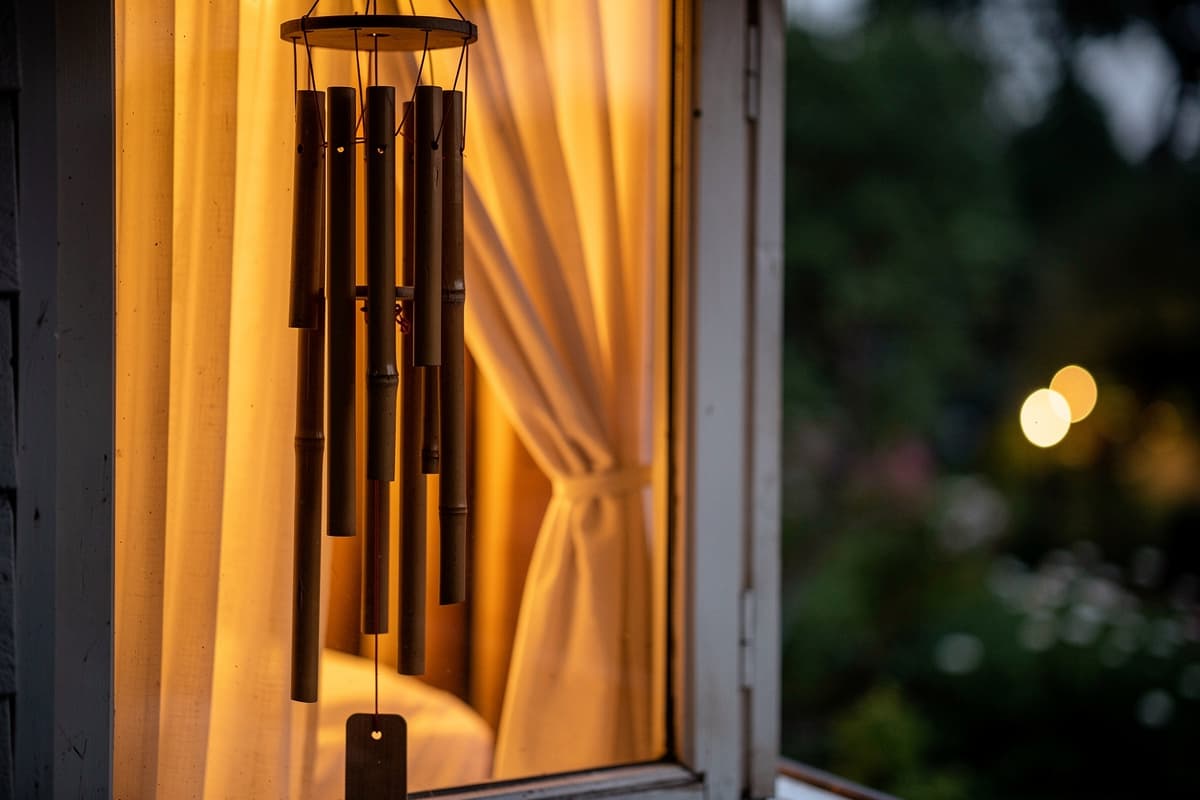
The right type of chime. Bamboo or wood for indoor or near-window placement. Metal chimes are louder and brighter, and their high-frequency content carries farther and is harder to ignore. In a small room with a cracked window, a bamboo set is warm and dry enough to blend into the background within a few minutes. A large aluminum set in the same position may be too much presence, too bright and sustained for the room. My bedroom chime is a five-tube bamboo set. I barely register it consciously, which is exactly the point.
Volume control through placement. You can't adjust the volume of wind chimes directly, but you can control it through placement and wind exposure. A chime that faces the prevailing wind will ring more often and more loudly than one in a sheltered corner. For sleep, you want a chime that speaks in gusts and falls quiet in the lulls. Constant chatter defeats the purpose.
Distance from the bed. Hanging a chime directly outside a bedroom window puts every strike loud and near. A better position is at a slight remove: around the corner of the house, further along a porch, or near an adjacent window instead of directly above your sleeping position. You want to hear it while falling asleep without letting the occasional loud gust strike jolt you at 2 a.m.
The right season and climate. In still summer weather, a wind chime near a bedroom window may simply not ring at all, which is neither helpful nor disruptive. In gusty autumn weather, the same chime might be so active it becomes a problem. Match expectations to conditions. In calm weather, a larger sail helps catch lighter breezes.
What Doesn't Work
Large metal chimes near a window. The sustain and brightness that make aluminum beautiful in a garden make it too sharp and present for a sleep environment. If you want to try metal chimes for sleep, smaller tubes (shorter, less sustained) work better than longer ones.
Chimes in constant heavy wind. A chime that rings continuously becomes an annoyance instead of an ambient backdrop. If your position gets steady strong wind, either choose a heavier, slower-responding chime or move it to a more sheltered spot.
Over-thinking it at the start. The first few nights with a new chime are the hardest, because you'll notice every strike. Give it a week. Habituation takes time, and the pattern of "wind chime at the window" needs to build a category in your auditory memory before it stops drawing attention. Almost everyone who sticks with it past the first few days reports the adjustment completing naturally.
My Setup
For what it's worth: bamboo, five tubes, hung on a bracket around the corner from the bedroom window so the sound comes in indirectly. The window stays cracked about two inches, enough air movement to activate the chime in a normal breeze but not enough to create a draft. I've been using the same setup for years. On nights when I forget to open the window, I notice the difference.
The simplest way to experiment before committing to an outdoor installation is to try Vibe Chimes on a phone or laptop with bamboo selected and the wind set to "calm" or "gentle." That's a reasonable approximation of what a well-placed bamboo chime sounds like at low volume in a quiet room, and a few minutes with it is usually enough to know whether the sound will work for you.
For more on why bamboo and wood behave differently from metal, see Aluminum vs. Bamboo vs. Wood Wind Chimes: Which Should You Choose?